
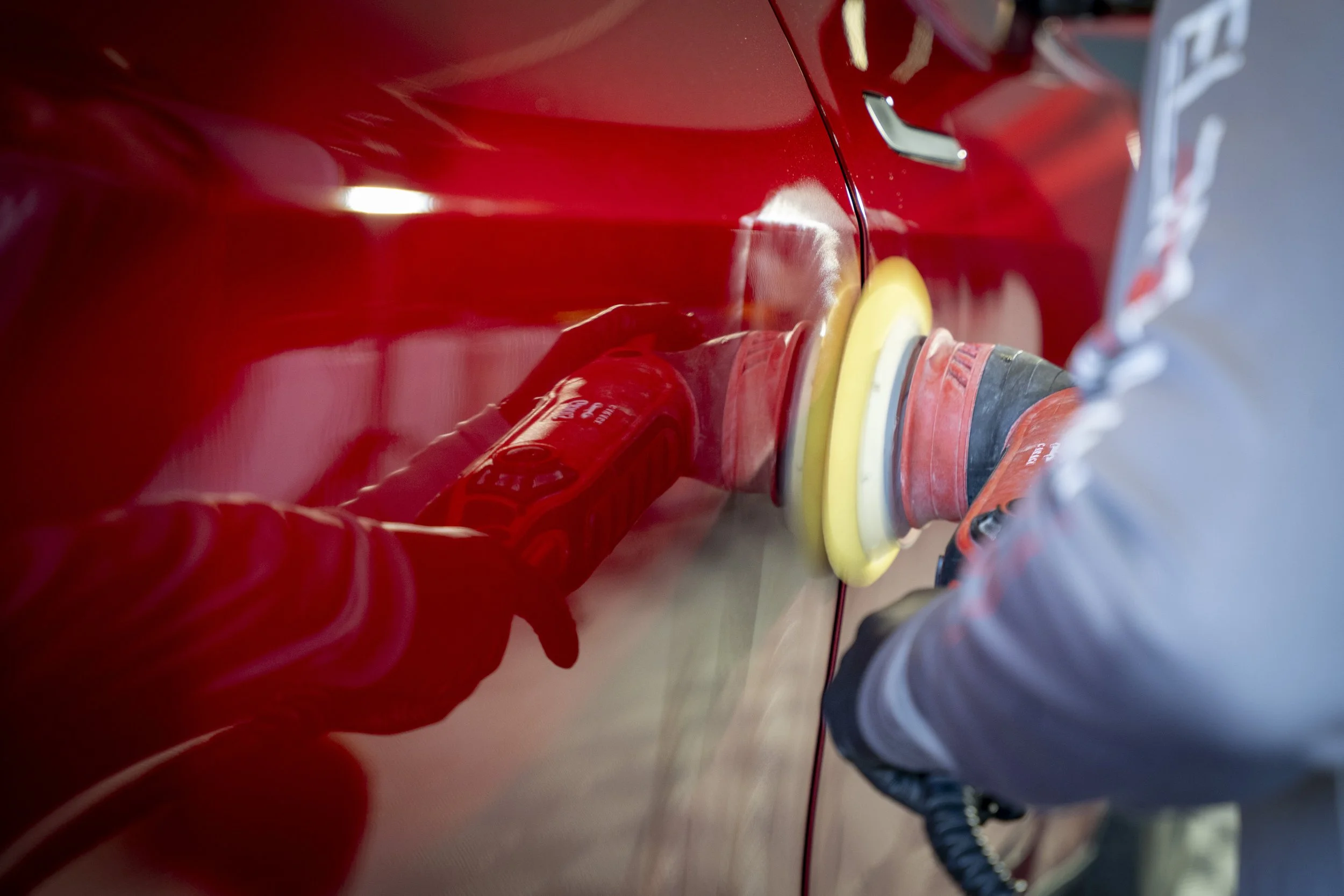
Paint Enhancement
Remove The Swirls and Get The Most Gloss and Clarity From Your Paint
Paint correction isn't just "buffing." It is a surgical process of leveling your vehicle’s clear coat to eliminate the "spiderweb" swirls and scratches that kill your paint’s depth. In the harsh NorCal sun, these imperfections become magnified, making even a clean car look dull and aged.
At Elements Detail, we don’t believe in a "one-size-fits-all" buffer. We use a data-driven approach to ensure we are restoring your shine without compromising the long-term health of your clear coat.
Our Precision-First Philosophy
Before a machine ever touches your paint, we perform a total surface analysis. We aren't just looking for scratches; we are looking at the "budget" of clear coat we have to work with.
Digital Paint Depth Readings: We use precision ultrasonic gauges to measure exactly how much clear coat is left. This is critical for modern cars due to how thin clearcoat come from the factory.
The "Judgment Call": Not every scratch should be removed. If a scratch is too deep, we prioritize Paint Health over "perfection." We’ll level it safely to round off the edges and make it invisible to the eye, rather than thinning your clear coat to the point of failure.
Controlled Environment: Whether in our Shingle Springs shop or under the canopy of our mobile unit, we use specialized lighting (high-CRI) to catch the micro-marring that standard garage lights miss.
Scalable Correction Levels
We tailor our stages to your specific goals and your vehicle's starting point:
The Gloss Enhancement (Single-Stage): Designed to remove light swirling and oxidation. This "All-in-One" or 1-Step approach recovers about 60-70% clarity and is perfect for daily drivers in Cameron Park and El Dorado Hills.
The Multi-Stage Restoration: Our intensive "Cut and Polish" process. We use a heavy compounding stage to pull out deep defects, followed by a ultra-fine finishing polish for that mirror-like, "dripping wet" look. This targets 90%+ correction.
Preserving Your Investment
Paint correction is the essential foundation before applying a Ceramic Coating. By leveling the surface, we ensure the coating bonds perfectly to the pores of the paint, locking in that "better than showroom" finish for years.


Even New Vehicles Need Paint Correction
It’s the biggest misconception in the car world: “It’s brand new, the paint must be flawless.” In reality, most vehicles arriving in El Dorado County have already endured months of transport on rail cars, sitting in dusty holding lots, and—worst of all—the "complimentary" dealership wash. Whether it’s a high-end SUV or a weekend sports car, we regularly see brand-new vehicles with heavy swirl marks, iron fallout, and "buffer trails" straight from the lot.
At Elements Detail, our New Car Restoration service is designed to strip away these factory defects and transport damage, revealing the true depth of your paint before we lock it in with a permanent ceramic coating.
The "Delivery Day" Reality Check
Before you took delivery, your vehicle likely faced:
Industrial Fallout: Tiny metal particles from rail transport that bond to your clear coat (especially noticeable on white or light-colored cars).
Aggressive "Lot Washes": Dealerships use high-volume, "one-bucket" methods that install those "spiderweb" swirls into your paint before the first oil change.
Sanding Marks: We often find factory-installed "pig tails" or sanding marks that the manufacturer missed during the final QC.
Our Meticulous 15-Hour Restoration Process
Because we prioritize "Better than New" results, this is our most time-intensive service. Depending on the size of your vehicle, a full new car restoration typically takes 8 to 20 hours of precision labor.
Chemical & Mechanical Decon: We start with an iron-decontaminating foam bath followed by a clay bar treatment to ensure the surface is surgically clean.
Multi-Stage Polishing: We don't just "wax" it. We use precision machines to level the factory clear coat, removing the "haze" that limits your car's gloss.
Final Inspection: We use high-output LED lighting to ensure every square inch of your paint is "flat" and reflective before any protection is applied.
Protecting Your Investment Long-Term
Once we achieve that mirror-like finish, we don't just hand you the keys and walk away. We help our clients in Cameron Park and Placerville maintain that correction:
"Never-Auto" Policy: We strongly advise against automated brush washes, which can ruin hours of our precision work in just 5 minutes.
Maintenance Education: Jayson and the team provide a "Post-Correction" guide, teaching you the same safe washing and drying methods we use in our Shingle Springs shop.
The Elements Detail Restoration: Our 12-Step Precision Process
At our Shingle Springs studio, we don't believe in "high-volume" turn-around. A true paint restoration isn't measured in minutes—it's measured in days. Whether we are prepping a rare Ford GT for a show or reviving a daily driver in Cameron Park, our 20-year refined process ensures your clear coat is respected and your finish is flawless.
Phase 1: Decontamination & Prep
1. Wheels, Barrels & Wells: We pull years of baked-on brake dust from the inner barrels and fender liners—areas most washes never touch.
2. The Hybrid Foam Bath: We blanket the car in a high-lubricity snow foam to lift Sierra dust. We follow this with a dedicated hand wash of the "hidden" areas: door jambs, fuel hinges, and intricate trim.
3. Chemical Iron Removal: We apply a specialized fallout remover that dissolves embedded metallic particles (those tiny orange dots often seen on white cars) that a clay bar alone can't reach.
4. Professional Clay Bar: We perform a mechanical "exfoliation" of the paint, pulling out bonded contaminants until the surface feels like smooth glass.
5. Precision Masking: We tape off every piece of delicate rubber, pebble-grain plastic, and chrome trim. This prevents "staining" from polishing oils and protects the edges of your trim.
Phase 2: The Correction Lab
6. Stage 1: Leveling & Compounding: Using a heavy-cut wool or foam disc, we safely level the clear coat to "floor" the deep swirls and oxidation.
7. Stage 2: The Jewel Polish: We transition to a ultra-fine finishing polish. This removes the "haze" from the cutting stage, bringing out the true depth and "dripping wet" look of your factory color.
8. The IPA "Truth" Wipe: We strip the paint of all polishing oils using Isopropyl Alcohol. This ensures the shine is real and not just hidden by fillers or residues.
9. Long-Term Shielding: We apply your choice of a premium sealant or a pro-grade Ceramic Coating to lock in the correction and provide years of hydrophobic protection.
Phase 3: The Finishing Touches
10. Trim & Tire Reconstruction: We use a non-sling, "factory-black" dressing on tires and plastics. No greasy residues—just a clean, hydrated look.
11. Precision Glass: We finish with a streak-free cleaning of all exterior glass and mirrors for maximum clarity.
12. The Master Inspection: The team performs a final multi-point walk-around under high-CRI lighting. If it doesn't meet our 20-year standard of excellence, it doesn't leave the shop.
How Long Do The Results Last?
The goal of our paint correction services is to remove the swirls, scratches, water spots, or any other form of imperfections from your paint to restore the gloss and clarity
So once we’re done with the job, the car will be shinning like never before. However, the key to maintain those results is proper maintenance. You shouldn’t take the car through an automated car wash where they use the high-speed bristles to wash your car. Reason being is the bristles basically slap your car the entire time, and if they have embedded dirt or debris in those bristles from previous washes, it’s simply going to scratch up your paint or even cause damage.
We see it all the time. We’ll get cars in our shop with deeper scratches across the paint because there was some rock or debris that was dragged along the paint while it was getting washed.
That’s why to keep your car looking it’s best you want to use the right tools, products, and techniques.
If you take your car somewhere for a hand wash where they’re using low-quality wash mitts and drying towels, that can start to abrade your paint and add swirls. It can take only a few washes to get your paint back to swirled and the gloss is gone again.
Whether we maintain the car for you or you do it yourself, the goal is to perform proper washes to keep your paint glossy.
When done properly, you might just need a light polish once every other year to clean up any light swirls from the paint and get it back up to standard.
What is a Ceramic Coating?
Ceramic coatings are the most popular option of protection after getting your car polished. A ceramic coating is a very durable form of paint protection that can last several years. The goal of the coating is to help repel the dirt, water, and road grime from your paint so it doesn’t stick to it.
And the next time you go to wash your car, you’ll give the car a rinse and a majority of the dirt and grime will sheet off. So it makes maintaining your vehicle much easier compared to if you didn’t have it on your car.
That being said, ceramic coatings do not help prevent rock chips or other forms of impact on your paint. That would be reserved more towards paint protection film.
The Right Tools and Products For Maximum Results
Polishing your vehicle’s paint to a like-new condition requires more than just a single tool or product. That’s why we use a range of professional-grade polishers, pads, and compounds to get the job done right. Here’s a breakdown of the key tools we rely on to remove swirls and bring back the gloss and clarity:
Polishers: The Foundation of the Process
Polishers are the backbone of any paint correction job. They come in different sizes like 1”, 3”, and 5” and in different types like a rotary, dual action, and forced rotation.
Each polisher serves a purpose depending on the vehicle, panel size or complexity, and clear coat type. For larger surfaces like the hood, we use a larger-throw machine to remove swirls efficiently. For tighter areas like bumpers, a smaller 3” polisher allows for more precision.
Pads: The Key to Cutting and Polishing
The pad is what makes direct contact with your paint and plays a crucial role in the correction process. Different brands offer their own pad styles, each designed for specific levels of cutting and polishing.
For heavy swirl removal, we typically use a wool pad paired with a rotary polisher—an aggressive but effective combo. Other options include microfiber and foam pads, which provide varying levels of cutting and polishing power. Before starting, we test different pad and compound combinations to determine the best approach for your vehicle’s paint.
Compounds & Polishes: The Final “Ingredient”
Just like polishers and pads, compounds and polishes come in a range of strengths. Some compounds are designed for heavy cutting, ideal for removing deep swirls and scratches. In those cases, we might use a rotary polisher with a wool pad and an aggressive compound to get the best results.
On the other end of the spectrum, fine polishes are used for the final refinement stage, helping to enhance clarity and bring out maximum gloss. Each step is carefully chosen based on your vehicle’s needs and what we’re trying to accomlish.
Paint Correction FAQs
Where are you located?
Our detail shop is located at 4020 Durock Rd. We’re right next to GS Smog. Depending on the level of work, it can take 2 to 3 days to complete the service. We also offer limited mobile detailing services to El Dorado County and surrounding areas (paint correction is shop-only).
What tools and products do you use?
We have a variety of polishers, pads, compounds, polishes, towels, and lights that we use to get the job done. We have 1″, 3″, and 5″ polishers to help us get into any small or tight area we need to polish. If there’s heavy swirls, we can use our more aggressive tools and pads to safely achieve the desired results.
Before we start the polishing process, we use our paint thickness gauge to read how much paint we have to work with. This is important to know so we don’t go overly aggressive on panels that don’t have the clear coat for us to do it. We don’t want to end up causing damage because we were chasing the swirls.
What’s the difference between a wax and paint correction?
A wax does not remove any swirls or scratches from your paint. It only hides the very light swirls and can be completed in a few hours. Paint correction actually removes the swirls in your paint. This is what makes the paint shine like crazy. It also takes a substantial amount of time and energy to complete. Usually one or two full days (depending on size, condition, and desired results)..
My paint is chipping. Can you still polish it?
If there’s panels on your paint that are chipping, cracking, or heavily oxidized, then there’s a chance it’s too far gone for us to work on. That being said, on the other panels, if they’re still in good condition, we can still polish them normally. But if the paint is at the point where can’t do anything, your next solution would be to get that panel repainted.
Does the color of the car matter when it comes to polishing paint?
The process will be the same but if you have a darker colored vehicle like black, you can see far more swirls and imperfections than you can with a lighter colored vehicle like white. Black is a great color but it’s often the most difficult to upkeep because you can see every little imperfection in the sun. With the color white, a lot of it is hidden because it blends in with the paint color.
How often do I need to polish my car?
It’s one of those services where you shouldn’t have to do it every year. You have a limited amount of clear coat on your paint and the more you polish it, the more you take off and thin it out. That’s why it’s important to maintain your vehicle with proper washing so you can prolong the results and not require your paint to be polished every year.
